
Oncotarget outrage and the Misinformation Machine

January 11, 2026
A curious story developed over the weekend that prompted much social media activity about a supposed bombshell new research article and the academic journal Oncotarget. Let me tell you, friends, about what I saw and the hijinks that ensued.
Oncotarget goes offline
I only caught wind of this whole debacle when I saw Dr. Wafik El-Deiry, professor at Brown University, complaining of censorship and a DDOS attack against the website of the journal Oncotarget, splashed across the social media platform X (formerly Twitter).
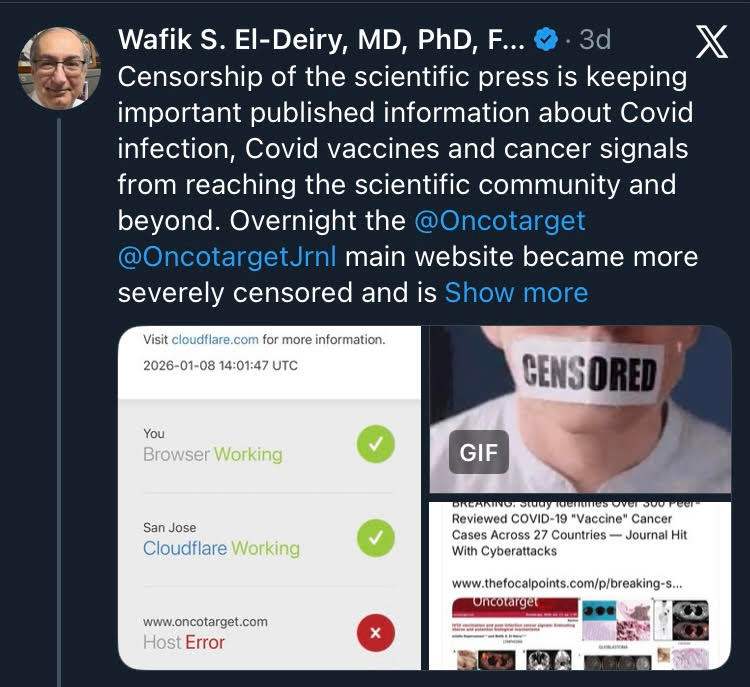
No proof of a DDOS attack was provided, merely that the website was offline, which indeed it was. Nevertheless, Dr. El-Deiry sprang into action, and opined in several X posts that Oncotarget was under attack by bad actors, that the anonymous mob was trying to silence two papers he had just published in the journal, and, of course, tagged everyone he could think to amplify his message of censorship.
Oncotarget, the target (!) of this purported attack, is a journal whose Editor-in-Chief is Dr. El-Deiry himself, and one that has been mired in controversy for more than a decade. Oncotarget has had a poor record of article retractions, de- and re-listings from MEDLINE, and does not currently have an impact factor — a measure which generally indicates the quality and academic rigour of a journal.
So the Oncotarget website goes down, ostensibly by a mob of bad actors, to censor a hot-off-the-press review paper: “COVID vaccination and post-infection cancer signals: Evaluating patterns and potential biological mechanisms”, authored by Charlotte Kuperwasser and, wouldn’t you know it, Wafik El-Deiry.
The paper in question
When I see science drama, I can’t help myself. I’ve got to see what all the hubbub is about. So, although the Oncotarget website was down, I hunted for the article and found a copy published on Dr. Kuperwasser’s Substack of all places (more on that later). This was on January 7th, 2026.
I read the paper with great interest, and, as a molecular biologist actively working in research, I felt well-equipped to fully understand the concepts of the paper and evaluate the quality and syntheses therein.
I was, let’s say, underwhelmed and unimpressed.
I found several errors, identified instances where the authors had misinterpreted literature they cited, and generally felt the quality of evidence to be very poor (although, as this was a review paper, you cannot fault the authors for poor quality of the published literature). Given the drama of the whole situation, I felt inspired to write a good-faith critique of the paper on PubPeer, under the handle Rubus acuminatus. I won’t go into great detail of my critique here, but I encourage everyone reading this to see the PubPeer comments on this article and come to your own conclusion about whether or not errors and misinterpretations of data were made in the paper.
Side note: identifying errors and offering critiques of published research is part of the scientific process. Revising and improving the existing literature allows for progress to be made and for the scientific record to be corrected - all in the pursuit of truth and knowledge. We should ALL reject the idea that valid criticism and identifying errors is a form of censorship or an otherwise bad-faith attack.
Beyond the issues I identified in the paper on PubPeer, there is an elephant in the room that was almost entirely overlooked in the article and is regularly ignored by those who spread misinformation that vaccines are causing an epidemic of turbo cancers1: there is no good epidemiological evidence to support such a causal link.
Let’s put our logic hats on for a second and consider that billions of doses of COVID vaccines (especially mRNA vaccines) have been administered globally, yet no broad-scale cancer safety signal has been found. At 5 years post vaccine approval, if cancers were being caused by cellular transformation with the LNP-mRNA platform (as is considered the major concern in the Kuperwasser and El-Deiry paper), there should be clear and obvious signal.
Another major flaw in the logic: if COVID vaccines reliably cause cancer, there should be a linear relationship between cancer incidence rate and the number of doses a person has received. For example, a person 5X vaccinated should have a 5X higher chance of getting cancer, but no such multiplicative signal exists. In fact, in one of few population studies that were referenced by Kuperwasser and El-Deiry, Acuti Martellucci et al. (2025) found that while there was a very modest increase in the risk of a few kinds of cancer for people who had received one or more doses of any kind of COVID vaccine, no increase was seen in people who had received three or more doses. I don’t know about you, but to me, this kind of trend makes very little biological sense if we hypothesize that vaccines cause cancer. Interestingly, Acuti Martellucci et al. report a very clear protective effect of COVID vaccination on all-cause mortality, which is evidence we have seen from numerous studies globally.
Now, it is still possible that a COVID vaccine could cancer, but the lack of any clear correlation and the continued lack of any causal evidence by 2026 indicates to me that there is no clear or consistent biological mechanism.
Strange timelines and a story most convenient
Here’s where the story gets really weird. While the Oncotarget website was down between January 3rd and 6th, and prior to the the “COVID vaccination and post-infection cancer signals” paper appearing on the website (which says was published on January 3rd), the paper had already been retrieved and combed through by science sleuths.
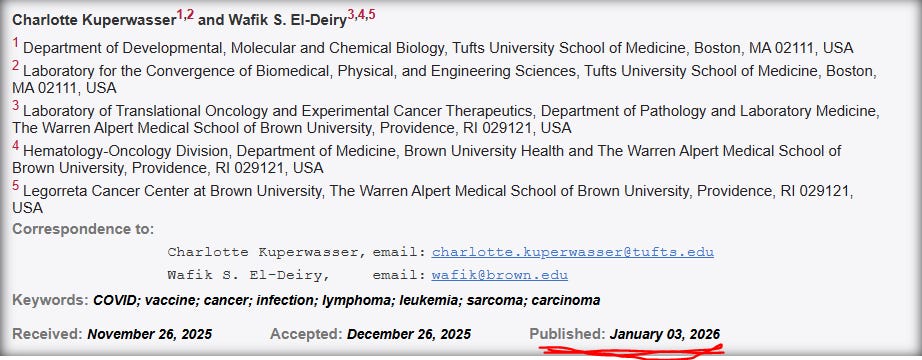
Post #1 on PubPeer highlights not only errors in the paper, but differences between the original paper and the version that finally appeared on the functioning Oncotarget website on January 7th!
Now, for those of you who do not publish articles in academic journals, this is very unusual. Typically, once an article is published, no more changes can be made without a formal resolution process. Almost always, changes made post-publication will result in a “Correction” notice being applied to the article.
I do not see any notice of Correction on the paper by Kuperwasser and El-Deiry.
Sometime on, or shortly after January 7th, the Oncotarget website went down again (boy, they really need to get a new server host). This was around the same time that more science sleuths, myself included, starting pointing out on social media and on PubPeer, additional errors and misinterpretations of data in the paper. Now I’ll say, that seems very convenient.
Is it possible that additional changes or corrections were being made to the paper while Oncotarget was down because of these “DDOS attacks”?
I’ve got my tin foil hat seated firmly on my head.
Folks, let’s do a quick thought experiment:
Say you are Editor-In-Chief of a science journal and you’ve published a paper in this same journal. Shortly after publishing, you receive feedback that there are errors in your paper. Other readers strongly disagree with your analysis and synthesis of the data.
Wouldn’t it be great to be able to make changes to your paper without anyone knowing?
As EIC, is it possible that you have access to the back end of the journal website? Is it possible that you could take the journal offline? No?
Well, if the website just so happened to go offline randomly, or maybe because of a cyberattack, maybe with this moment of convenience, you could make changes and post the updated article by the time the journal comes back online (or whenever those pesky cyber criminals knock it off)? Wouldn’t this be great?
Better yet, you could let everyone else know that you’ve been the victim of cybercriminals! And a nebulous censorship mob! And everyone around you will believe you, because you’ve got a network of conspiracy theorists supporting your work.
Err… well… I guess not everyone will believe you.
Anyways, I digress. We can only draw so many conclusions from a thought experiment.
Substack articles disappear
Like any good sleuth, I sought out information about the authors of this paper, which led me to Dr. Kuperwasser’s Substack.
And what luck! It appeared that Dr. Kuperwasser had published a four-part series of articles, The Third Rail: COVID Vaccines and Cancer, discussing potential links between COVID vaccines (or much less frequently discussed, COVID infection).
Err… at least it was a four-part series.
Part 4 of the series described the Oncotarget paper in question, highlighting some of the key takeaways, but also contained an entire copy of the paper, which was how I originally read the paper while the journal website was down on January 6th. As I mentioned previously, I read the paper with great interest, and lo and behold, I found errors and misinterpretations of reference materials.
In the spirit of scientific discourse, on January 7th I left a good faith comment on the Part 4 article, describing my concerns about the Oncotarget paper.
And what happened next?
Well, the post disappeared entirely the next day!
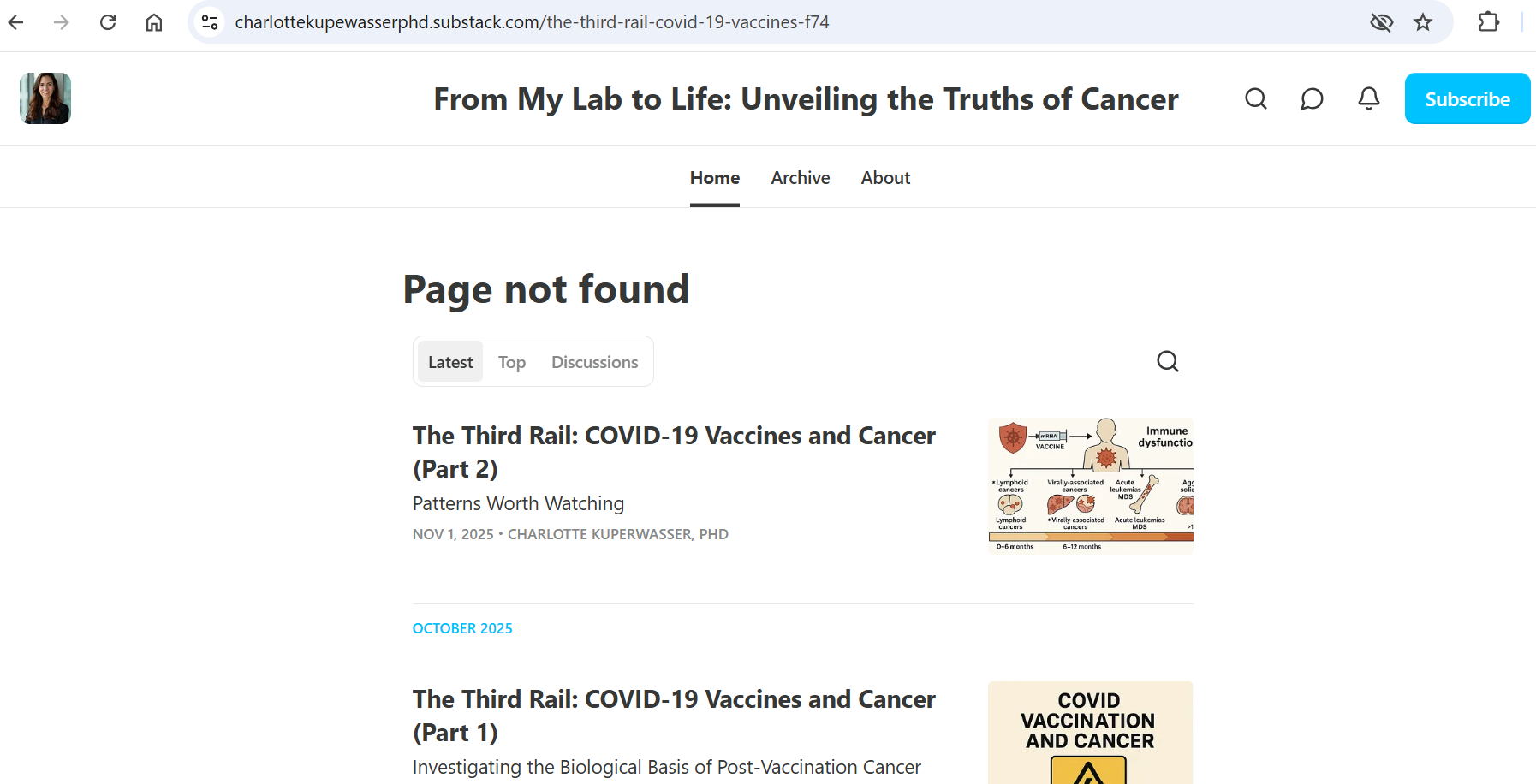
My attempts to access the webpage for article using my browser history only yielded a “Page Not Found” error (per image above), nor could I recover it through the Wayback Machine.
I reposted my comment on the Part 3 of the series, which also disappeared the next day. To date, only Parts 1 and Part 2 of the series remain.
To me, it seems a strange choice to delete a post entirely, rather than respond to a comment in good faith, as Dr. Kuperwasser has done in other posts on her Substack.
I’m tapping my tin foil hat again… could it be that there is something to hide?
It couldn’t possibly be an act of censorship…
The Misinformation Machine
Back on X, Dr. El-Deiry has been very successful at activating the Misinformation Machine. He used a tried and tested method: tag everyone you know in your social media posts 😅.
This sort of machine is a common occurrence now in (typically right-wing) social media spheres: a claim is made - whether truthful or not - then without any second thought, careful appraisal of the evidence, or regard for the impact of the claim, it is whisked away and exponentially amplified through social networks - often twisted, distorted, and bent further from the truth along the way.
And boy, regarding this paper, the Machine worked its magic! The tendrils of the Machine gnarled their way to US politicians, the Daily Mail (a media source renowned for their truthful and rigorous reporting), and even far-right activists like the white nationalist Tommy Robinson.
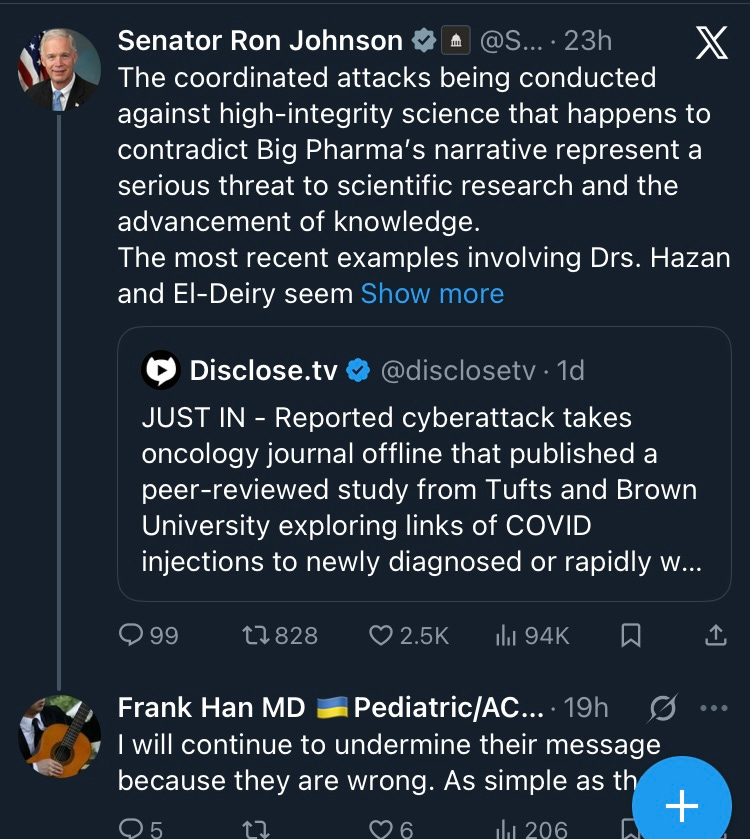
With this far of a reach, it sure would be bad if the original claim was misinformed, right?
Most concerning was that it became clear that Dr. El-Deiry encouraged, or at the very least allowed, the misinformation to spread. A post from notable dumbass and D-list celebrity Rob Schneider proclaimed to his millions of followers on X that the “Covid 19 jab causes cancer”. And Dr. El-Deiry simply replied to it with a post about Oncotarget being down due to supposed censorship:
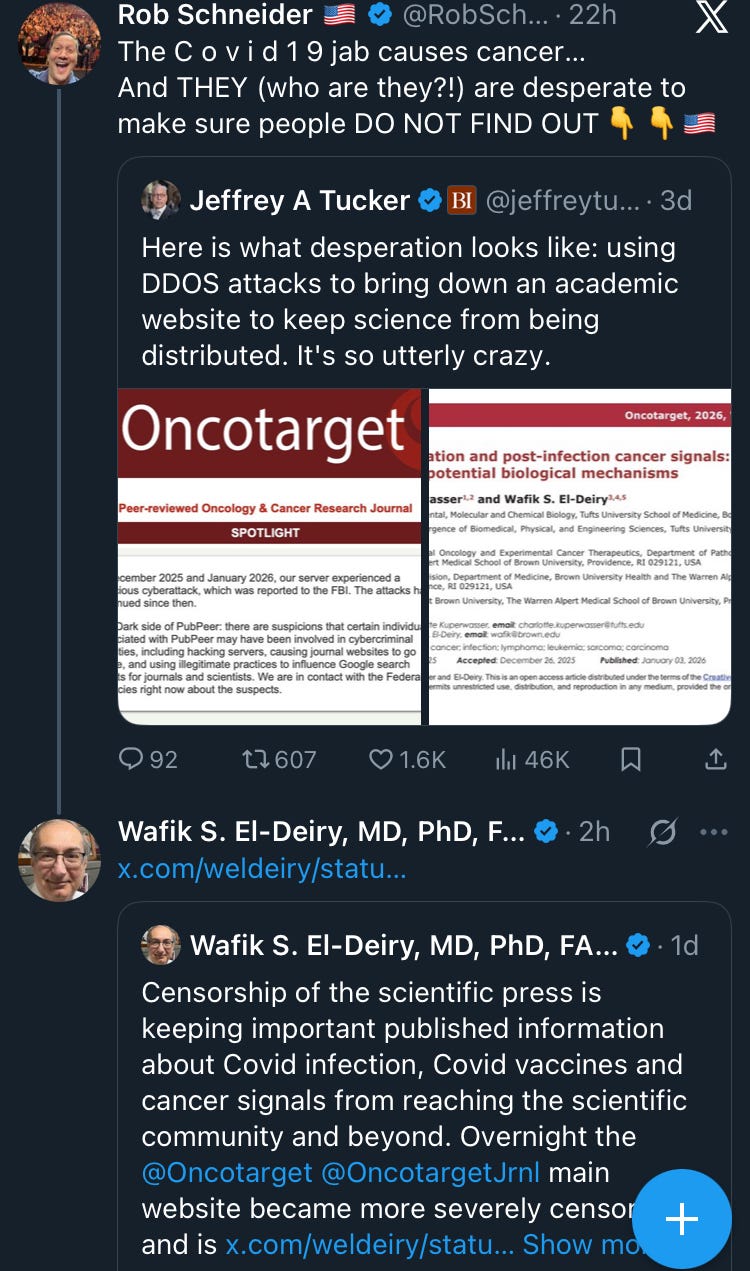
Dr. El-Deiry knows this is a distortion of the findings and conclusions of his Oncotarget paper, which specifically state that there is not enough evidence to prove a causal link:
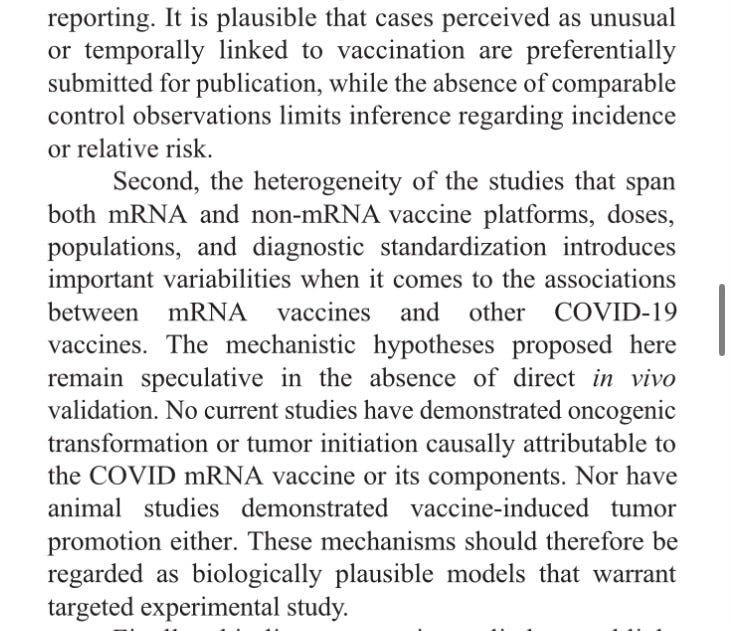
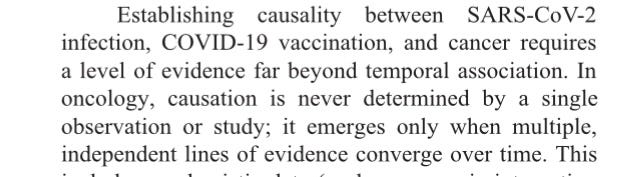
Dr. Kuperwasser herself acknowledges this in her blog post from October 2025:
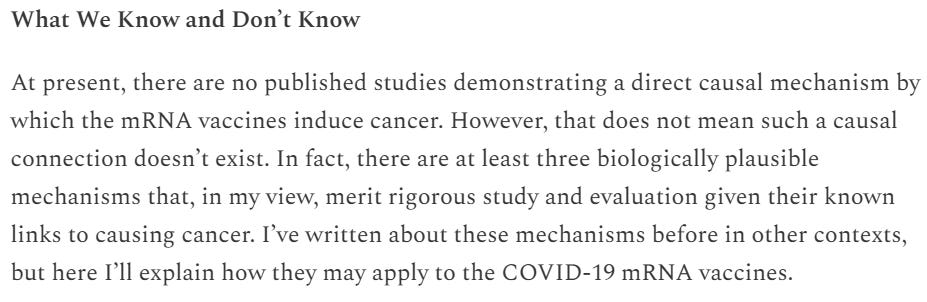
But from Dr. El-Deiry on X, there was no correction. No refutation of this claim.
To me, the silence here is a tacit endorsement of the messaging promulgated by the Misinformation Machine. In fact, the Machine is so well-oiled now that people can just let it work its magic (i.e. spread false information), while wiping their hands clean of any misdeed or wrongdoing. Because after all, they didn’t say it, their followers did.
I won’t mince words here: this is gross behaviour and very unbecoming of an esteemed researcher.
It is incumbent on all of us to stand up for science and research integrity. Those of us care deeply about the pursuit of truth and knowledge should all be gravely concerned about the Misinformation Machine and malign actors associated with such networks. I will write at more length about the Machine, the extent of its reach, and the implications of such a destructive force in future posts.
We have reached a point where bad actors, grifters, and anti-science activists have gained such closeness to power (heralded in by the MAHA movement2), that they feel so emboldened to actually threaten those of us who dare to debunk and correct the scientific record3:
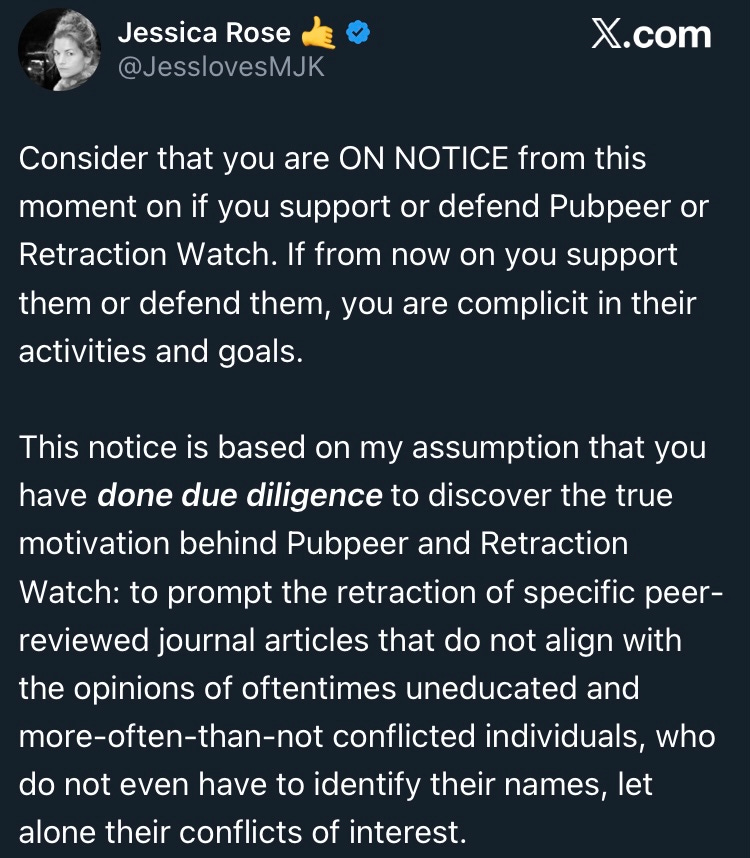
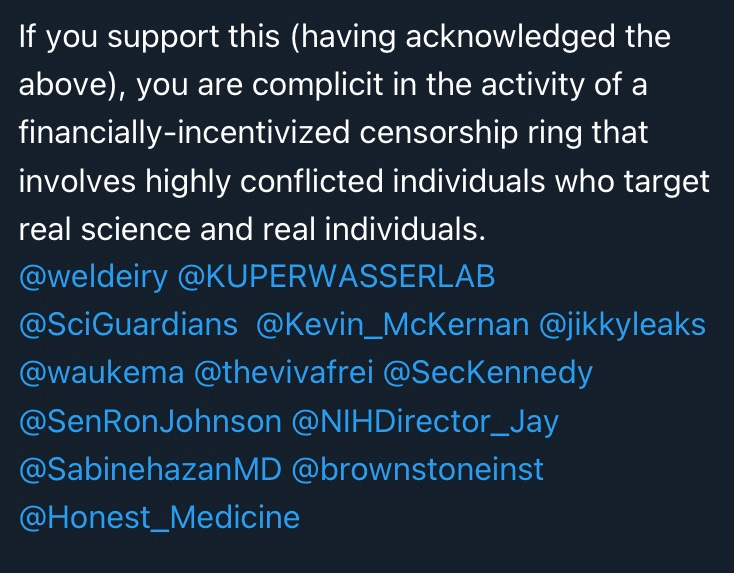
Let’s be very clear here: threatening people with state power (e.g. tagging government officials) is a far more extreme act of censorship and attempts at stifling scientific discourse than a PubPeer post could ever be.
More misadventures to come. Stay tuned, friends.
Turbo cancer is not a real, medically recognized condition.
A interesting note, Dr. Kuperwasser and Dr. El-Deiry appear to be contributing to US ACIP meetings and are providing advice to those in the highest levels of government. I sure hope that they always adhere to the oft-promoted by HHS “gold standard” of science
I was inspired to finally launch my Substack (after 3 years of mulling it over) because of this insane threat. Shoutout to Jessica Rose - author of several retracted papers - if you’re reading this!
Substack was the OG facilitator of this type of longform legitimate appearing misinformation - and continues to feature it and profit from it bigly. The top 5 most widely subscribed "Health Politics" newsletter are nearly always lying grifters - ascarr most of the top 10.
And Canadian failed scientist and outrage clown, Jessica Rose has been shoveling shit on here for years to an adulating (and lucrative, I assume) audience.
Once again, follow the money.
Conflict of interest checks are essential.
Lastly, take note of those who refuse to defend their positions
in live town hall style forums and who instead hide behind
compromised media outlets.